



Session 1

Artificial Intelligence

From Smart Tools to Strategic Thinking

This program builds students’ understanding of artificial intelligence while helping them think creatively, critically and ethically about how it works in the real world. Students learn how AI models function, how to interact effectively with chat-based tools and agents, how to evaluate AI-generated content and how to use AI for idea generation, communication, problem-solving and simple product creation—no coding experience required.

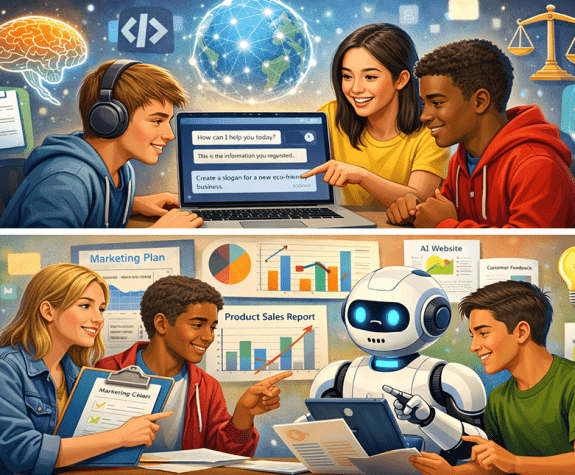
Students learn by using AI, not just studying it. They write and refine prompts, compare weak and strong outputs, test model performance and explore how AI behaves across different tasks. Through simulated business activities, they create slogans, promotional emails, product descriptions, customer responses and social media captions, while also using AI to interpret simple charts and datasets related to sales, feedback, scheduling and inventory. Group challenges and discussions help them identify where AI adds value, where it falls short and why human judgment, ethics and oversight still matter.
Curriculum

The curriculum combines technical understanding with hands-on practice so students learn not just what AI is, but how to use it well. Through creative exercises, business applications and critical discussion, students build the skills to work with AI thoughtfully, strategically, and ethically.

  • Build a practical understanding of how artificial intelligence works, including core AI concepts, chat-based tools and agents.
  • Learn how to write effective prompts, evaluate AI-generated content and compare model performance across different tasks.
  • Use AI to support idea generation, communication, problem-solving and simple product creation without prior coding experience.
  • Create business-focused content for simulated companies, including slogans, promotional emails, product descriptions, customer responses and social media captions.
  • Explore how AI supports decision-making by interpreting simple charts and datasets related to sales, customer feedback, scheduling and inventory.
  • Participate in hands-on challenges that test how AI performs in creative, analytical and communication-based scenarios.
  • Examine where AI appears in everyday business settings and when human judgment, ethics and oversight remain essential.
  • Leave the program able to use AI more strategically, think more critically about its strengths and limits and apply it to both creative and business-oriented work.
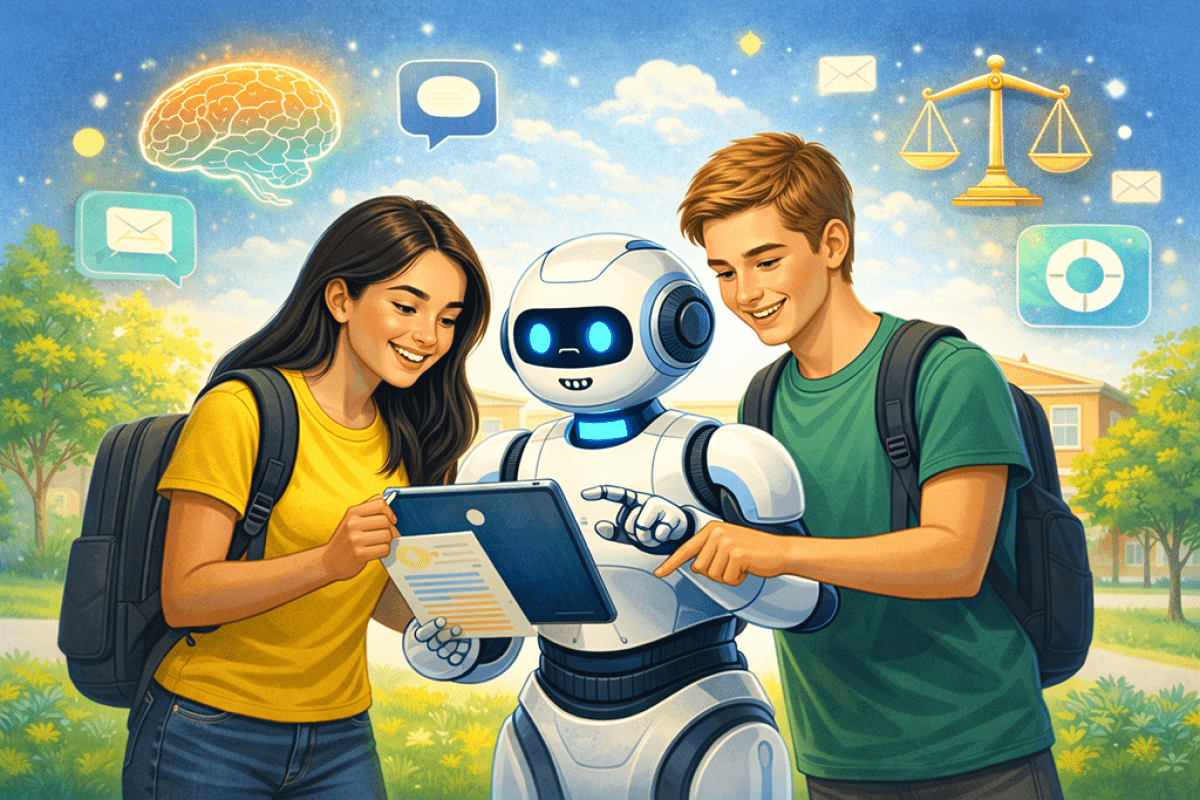
AI program illustration
Planned Topics

Planned topics introduce both the foundations of artificial intelligence and the larger questions that come with using it responsibly. Students examine how AI systems generate responses, where they are useful, where they fall short, and why human judgment, ethics, and oversight continue to matter.

  • Explore how artificial intelligence works, including generative AI, chat-based tools, and agents.
  • Learn how prompts shape results and how stronger prompting improves output quality.
  • Compare responses across different AI models and evaluate their reliability, usefulness, and limitations.
  • Examine the role of AI in reasoning, creativity, communication, and decision-making.
  • Discuss major questions surrounding the AI age, including bias, human oversight, reliability, the Turing test, and what it means for a machine to appear intelligent.
  • Investigate how businesses use AI for marketing, communication, customer service, forecasting, inventory planning, and customer feedback analysis.
  • Explore how AI can support the creation of websites, apps, and business content without a traditional coding background.
  • Test AI-generated outputs through hands-on evaluation, student-designed challenges, and team-based business simulations.
  • Consider how AI supports innovation while still requiring human creativity, responsibility, and ethical leadership.
Summer Institute Logo
Julia Olivieri
Faculty Lead
Julia Olivieri

Assistant Professor of Computer Science

PhD, Computational & Mathematical Engineering, Stanford University, 2022
MS, Computational & Mathematical Engineering, Stanford University, 2022
BA, Mathematics, Oberlin College, 2016
BA, Biology, Oberlin College, 2016

Dr. Olivieri's research lies at the intersection of computer science, biology and statistics. Her projects include developing algorithms to perform large-scale, rigorous analysis of RNA sequencing data, improving the statistical fidelity of differential RNA sequencing analysis, and evaluation of AI solutions to problems in computational biology. In the classroom, Dr. Olivieri takes a hands-on approach to introducing students to new subjects, with a focus on courses related to discrete math, data analysis and computational biology.

Faculty Lead
Amit Lal

Visiting Professor of Information Systems, Eberhardt School of Business

Ed.D., Benerd School of Education, University of the Pacific, 2022

Dr. Amit Lal is a Professor of Information Systems with expertise in AI-driven analytics and virtual learning environments. His research centers on integrating advanced technologies into education, empowering students to build critical thinking skills through practical, real-world applications.

Take the Next Step