

Breadcrumb
The first medical school in the West: Pacific’s history of educating physicians
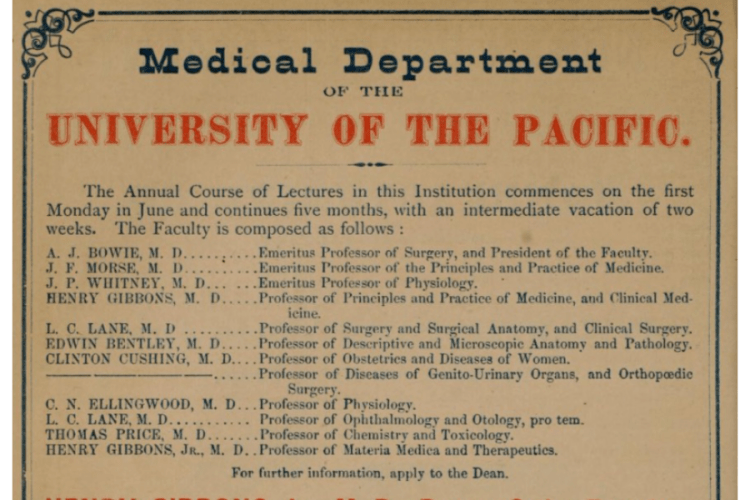
An advertisement for the University of the Pacific Medical Department from 1858.
Less than a decade after University of the Pacific’s 1851 founding as California’s first college, the small school soon took on another first—expanding beyond its liberal arts foundation to become home to the first medical school in the West.
Founded in San Francisco in 1858 as the “Medical Department” at Pacific, the school emerged at a time when there were fewer than 50 medical schools in the entire United States and none west of Missouri.
Four faculty members and 13 students made up the inaugural class, and 44 students would go on to graduate. Though most students came from San Francisco, the program also drew future physicians from Nevada, Oregon, the Midwest, Japan and Australia.
The medical school eventually separated from Pacific and became an independent entity called Cooper Medical School. Stanford University purchased Cooper Medical in 1908 to open its own medical department, which eventually became the Stanford University School of Medicine.
According to former Provost Philip N. Gilbertson in his book “Pacific on the Rise,” the idea of bringing a medical school back to Pacific resurfaced in the early 1960s under the leadership of President Robert E. Burns.
Burns helped lay the groundwork for that goal in 1962 when Pacific partnered with the Institute of Medical Sciences in San Francisco. The institute needed university affiliation to grant medical degrees, which Pacific was able to fulfill by establishing a “Graduate School of Medical Sciences.”
At the same time, Pacific’s Board of Regents approved a “School of Medical Technology” in partnership with Sutter Community Hospitals in Sacramento. Students in the program enrolled at Pacific for three years and then did one year with Sutter, though the partnership only lasted until 1968.
The university is now poised to return to its medical school roots. Under the leadership of President Christopher Callahan, the Board of Regents voted in May to approve the new School of Medicine, expanding on the university’s long history of educating health care professionals through the Arthur A. Dugoni School of Dentistry, Thomas J. Long School of Pharmacy and School of Health Sciences. Pacific plans to open the School of Medicine in 2030, pending accreditation approvals.
“As the first and oldest university in California, Pacific is rooted in a legacy of opportunity and innovation,” Callahan said. “The School of Medicine will build on our long-standing strengths in health care education while serving our communities, which is a core tenet of who we are as Pacificans."
California’s Central Valley has a severe and growing physician shortage with an urgent need for more doctors trained in the region. Research has shown that physicians are more likely to remain and practice in the communities where they complete their education and residency training.
More than 170 years after Pacific first began educating physicians, the university will once again provide much-needed medical education, expanding access to health care for the Central Valley and beyond.